
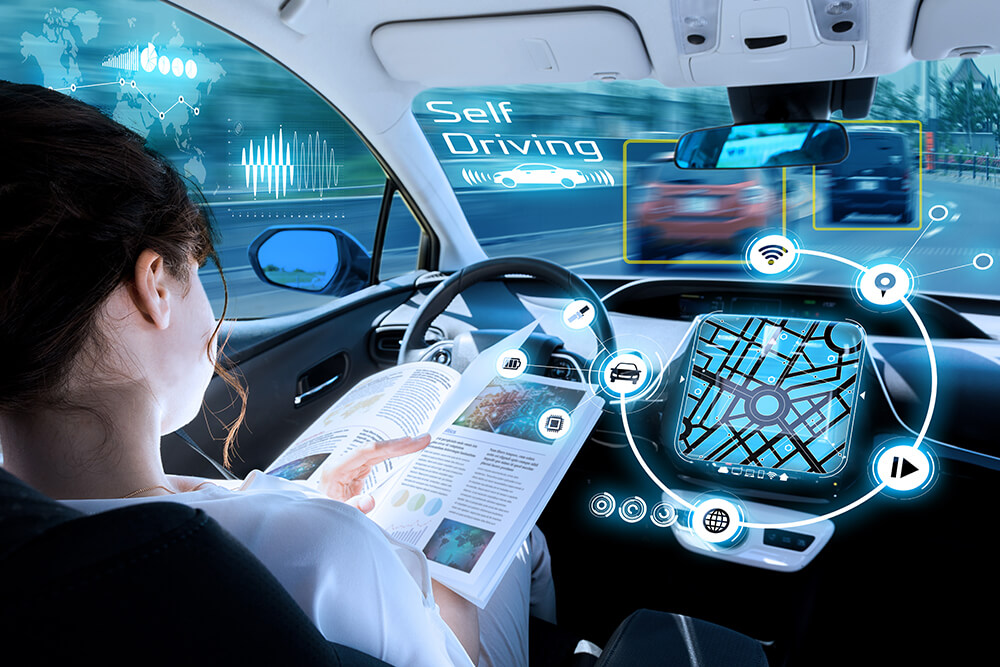

The Science of Self-Driving Cars: How Autonomous Vehicles Think and Drive
Self-driving cars are no longer the stuff of science fiction. Powered by artificial intelligence, sensors, and advanced algorithms, autonomous vehicles (AVs) are revolutionizing the way we travel. But what is the science that allows a car to “see,” “think,” and “act” on its own? In this in-depth article, we’ll explore the fascinating technologies and innovations driving the future of autonomous transportation.
1. Understanding What a Self-Driving Car Is
A self-driving car is a vehicle capable of navigating and operating without human input. It uses sensors, cameras, radar, and AI software to perceive its environment, make decisions, and move safely from one point to another.
The Society of Automotive Engineers (SAE) defines six levels of driving automation — from Level 0 (no automation) to Level 5 (full automation). Most current models, such as Tesla Autopilot or Waymo vehicles, operate at Levels 2–4, meaning they still require some human supervision.
2. The Core Technologies Behind Autonomous Vehicles
Self-driving cars rely on a combination of sensors, AI, and control systems to function. Each component plays a vital role in perception, decision-making, and motion planning.
- LiDAR (Light Detection and Ranging): Uses laser beams to create 3D maps of surroundings, helping the car “see” obstacles and measure distance accurately.
- Radar Sensors: Detect the speed and position of objects, especially in poor weather conditions.
- Cameras: Provide visual data to recognize road signs, traffic lights, pedestrians, and lane markings.
- GPS and IMU: Combine satellite navigation with motion sensors to determine the vehicle’s exact location.
These technologies continuously feed data into the car’s AI system, creating a real-time model of the driving environment.
3. Artificial Intelligence: The Brain of the Self-Driving Car
The real “driver” of a self-driving car is its artificial intelligence (AI). Using machine learning and neural networks, the AI processes massive amounts of data from sensors to make split-second decisions. The more data it receives, the smarter it becomes.
For instance, AI can distinguish between a pedestrian crossing and a shadow on the road, predict the behavior of other drivers, and even optimize routes for fuel efficiency. This advanced decision-making mimics human reasoning — only faster and more precise.
Related reading: Understanding Neural Networks | Machine Learning in Business
4. The Role of Deep Learning and Data
Deep learning, a subset of AI, allows self-driving cars to “learn” from experience. By processing billions of real-world driving miles, vehicles improve their ability to recognize complex road scenarios. Companies like Waymo and Tesla collect data from millions of sensors daily to enhance safety and reliability.
Self-driving algorithms are trained using simulation environments that mimic real-world traffic conditions. These digital worlds allow developers to test extreme weather, complex intersections, and pedestrian unpredictability without real-world risks.
5. How a Self-Driving Car Makes Decisions
Every action a self-driving car takes — from braking to turning — follows a complex process called the Perception-Planning-Control pipeline:
- Perception: Sensors detect the environment — objects, lanes, traffic lights, and signs.
- Planning: The system determines the safest path and anticipates future scenarios.
- Control: The car’s onboard computer adjusts speed, steering, and braking to execute the plan.
This pipeline runs dozens of times per second, ensuring that the vehicle reacts instantly to its surroundings. The continuous feedback loop between sensors and AI forms the basis of safe and smooth autonomous navigation.
6. Challenges in Autonomous Driving
Despite remarkable progress, fully autonomous vehicles still face several challenges:
- Weather and Lighting: Rain, fog, and low light can interfere with camera and sensor performance.
- Ethical Dilemmas: Deciding who or what to prioritize in unavoidable accident scenarios remains controversial.
- Regulations and Liability: Laws differ globally, raising questions about responsibility and insurance.
- Cybersecurity: Self-driving cars must be protected from hacking and data breaches.
These issues require collaboration between engineers, policymakers, and ethicists to ensure the safe deployment of autonomous technology worldwide.
7. Communication Between Cars: The Role of 5G
For autonomous vehicles to work efficiently, they must communicate not only with their environment but also with other vehicles — a concept known as Vehicle-to-Everything (V2X) communication. This is where 5G technology plays a crucial role.
With ultra-low latency, 5G allows cars to share data about speed, traffic, and hazards almost instantly. This enables smoother coordination, reducing accidents and traffic congestion in connected cities.
8. The Future of Self-Driving Technology
The future of technology trends points toward fully autonomous vehicles within the next decade. Advances in AI, robotics, and computing power are accelerating development. Major players like Waymo, Tesla, Apple, and Baidu are racing to perfect their Level 5 prototypes.
Moreover, autonomous driving is expanding beyond personal vehicles — to trucks, delivery drones, and even public transport. This shift promises not only safer roads but also reduced emissions and increased accessibility for people with disabilities.
9. The Environmental Impact of Autonomous Vehicles
Self-driving cars have the potential to reduce pollution by optimizing routes and energy usage. When combined with electric vehicles, autonomous driving could dramatically lower carbon emissions. Smart algorithms ensure efficient acceleration and braking, conserving battery life and energy.
10. Ethical and Social Considerations
As cars become more intelligent, they raise ethical questions: Who is responsible in case of an accident? Should the AI prioritize the passenger or pedestrians? The industry is still debating these issues while striving to maintain transparency and accountability in autonomous decision-making.
Conclusion
The science of self-driving cars is a fusion of robotics, AI, and data engineering. From LiDAR sensors to deep learning algorithms, every innovation brings us closer to a world where machines drive more safely than humans. As technology evolves, autonomous vehicles will not only change how we travel — they’ll redefine what “driving” means altogether.