

Understanding Quantum Computing: The 2026 Perspective on a Digital Revolution
Table of Contents
- Introduction
- What is Quantum Computing?
- Bits vs. Qubits: The Fundamental Difference
- Superposition and Entanglement: The Core Principles
- Why Quantum Computing is a Game-Changer
- Real-World Applications in 2026
- The Synergy Between AI and Quantum Computing
- Cybersecurity and the Post-Quantum Era
- The Challenges: Error Correction and Stability
- Future Outlook: Beyond 2026
- Conclusion
Introduction
As we stand in late 2025 and look toward the innovations of 2026, the computing world is on the brink of its most significant shift since the invention of the transistor. For decades, classical computers—from the smartphone in your pocket to the world’s most powerful supercomputers—have relied on the same fundamental logic: processing information in binary bits of 0s and 1s. However, we are reaching the physical limits of how small and fast these classical chips can become. This is where Quantum Computing enters the stage. By harnessing the strange and counter-intuitive laws of quantum mechanics, these machines promise to solve problems that would take today’s most advanced supercomputers thousands of years to calculate. In 2026, we are witnessing a transition from purely academic research to practical, hybrid workflows where quantum power is beginning to augment classical systems in fields as diverse as medicine, finance, and artificial intelligence.
What is Quantum Computing?
At its simplest level, quantum computing is a new way of processing information based on the principles of quantum physics, the science that describes nature at the scale of atoms and subatomic particles. Unlike classical computers which use deterministic logic, quantum computers are inherently probabilistic. They don’t just follow a single path to an answer; they can explore multiple possibilities simultaneously. This is not just a faster version of what we already have; it is a fundamental shift in how “work” is done by a processor. In 2026, companies like IBM, Google, and IonQ are deploying systems with hundreds of physical qubits, moving the industry into the “Late-NISQ” (Noisy Intermediate-Scale Quantum) era. While these machines are still delicate and require temperatures colder than outer space to operate, their ability to perform complex simulations is already providing a distinct computational advantage in specific research sectors.
Bits vs. Qubits: The Fundamental Difference
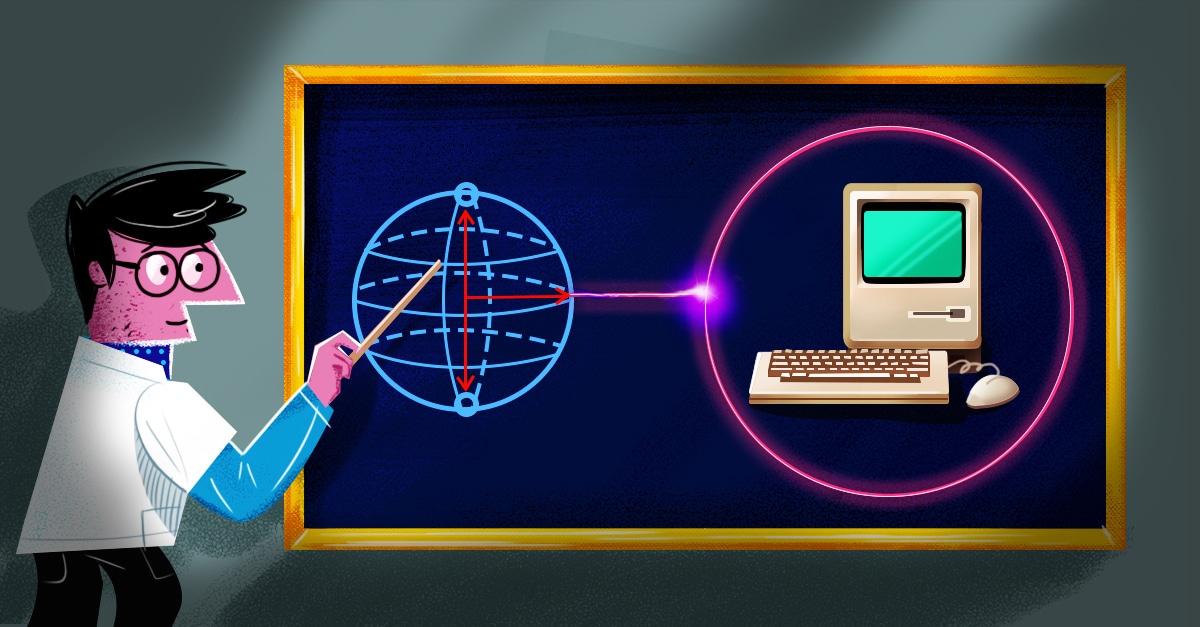
To understand the power of a quantum computer, you must first understand its basic unit of information: the qubit (quantum bit). In a classical computer, a bit is like a light switch that can be either “On” (1) or “Off” (0). A qubit, however, can exist in a state of 0, 1, or both at the same time. This doesn’t mean it’s “in between” the two values; rather, it exists in a complex mathematical state that allows it to represent much more information than a single bit. By the time we reach 2026, the technology shaping human evolution has advanced to the point where we can manipulate these qubits with extreme precision using microwaves or laser pulses. While a classical computer with $n$ bits can represent only one state out of $2^n$ possibilities at a time, a quantum computer with $n$ qubits can represent all $2^n$ states simultaneously, giving it an exponential advantage as the system scales.
Superposition and Entanglement: The Core Principles
The magic of quantum computing lies in two main phenomena: Superposition and Entanglement. Superposition is what allows a qubit to be in multiple states at once, enabling the parallel processing of massive datasets. Entanglement is even stranger; it is a unique link between qubits where the state of one qubit is directly tied to the state of another, even if they are miles apart. Einstein famously called this “spooky action at a distance.” In a quantum computer, entanglement allows qubits to work together in a highly coordinated fashion, exponentially increasing the machine’s processing power with every qubit added. As ai agents explained functions types often involve complex optimization, these quantum properties are being used to find the “best” path through millions of variables in seconds, a task that would paralyze a traditional binary processor.
Why Quantum Computing is a Game-Changer
The reason the world’s leading governments and tech giants are investing billions into this field is that quantum computing can tackle “exponential” problems. Most of the world’s biggest challenges—like simulating the behavior of new molecules or optimizing global logistics—are currently unsolvable by classical means because the number of variables grows too fast for binary logic to keep up. Quantum computers thrive in this complexity. By 2026, the use of ai assistants making life easier for researchers includes quantum-backed simulations that can predict how a new drug will interact with human proteins without ever touching a lab bench. This has the potential to turn decades of trial-and-error research into months of precise digital calculation, fundamentally accelerating human progress in science and engineering.
Real-World Applications in 2026
As we move into 2026, the applications of quantum computing are becoming increasingly tangible. In the pharmaceutical industry, quantum models are being used for high-fidelity molecular simulation, leading to breakthroughs in personalized medicine. In finance, banks are testing quantum algorithms for risk assessment and portfolio optimization, identifying market patterns that were previously invisible. Logistics companies are utilizing “Quantum Annealing” to solve the traveling salesman problem at a global scale, optimizing shipping routes to save fuel and time. The future of robotics and automation is also being influenced by quantum computing, as these machines require real-time pathfinding in complex environments. While we haven’t reached “Universal Quantum Supremacy” for all tasks, these specialized “Quantum Advantage” proofs are demonstrating measurable performance gains over classical computing alone.
The Synergy Between AI and Quantum Computing
One of the most exciting trends for 2026 is the convergence of Artificial Intelligence and Quantum Computing, often referred to as Quantum Machine Learning (QML). AI requires massive amounts of data and processing power to train models, and quantum computers provide a way to speed up this training exponentially. Quantum algorithms can help AI systems recognize patterns in multidimensional data that classical silicon chips would miss. Using ai tools to study faster and process information more deeply, developers are beginning to integrate quantum-ready libraries into popular SDKs. This synergy is a two-way street: AI is also being used to help scientists design better quantum hardware and more efficient error-correction codes, creating a feedback loop of innovation that is accelerating both fields simultaneously.
Cybersecurity and the Post-Quantum Era
With great power comes great risk. One of the primary capabilities of a large-scale quantum computer is its ability to break the encryption that protects almost all of our digital communication today, including RSA and ECC. This threat has led to the urgent rise of “Post-Quantum Cryptography” (PQC). In 2026, we are seeing cybersecurity getting much stronger as governments and enterprises transition to quantum-resistant algorithms. While a “Quantum Doomsday” where all encryption is broken is still years away, the “harvest now, decrypt later” strategy used by bad actors means that protecting data today is critical. For users of wearables tracking smart activities and other personal devices, this shift means that the next generation of software updates will include new, quantum-safe encryption layers to ensure long-term data privacy in a post-quantum world.
The Challenges: Error Correction and Stability
Despite the hype, building a reliable quantum computer is one of the hardest engineering challenges humanity has ever faced. Qubits are incredibly fragile; the slightest change in temperature, light, or magnetic field can cause them to lose their quantum state, a process known as “decoherence.” This leads to errors in calculations. In 2026, the industry is heavily focused on Quantum Error Correction (QEC), which uses multiple physical qubits to create a single “logical” qubit that is stable enough for long computations. The ethics of artificial intelligence used in these systems are also being debated, as the ability to break encryption and simulate biology carries significant responsibility. Overcoming these hardware bottlenecks is the final bridge that must be crossed before quantum computing can move from specialized research labs into everyday business operations.
Future Outlook: Beyond 2026
Looking beyond 2026, the goal is “Fault-Tolerant Quantum Computing”—machines with thousands or millions of qubits that can run complex algorithms without errors. We expect to see the rise of “Quantum-as-a-Service” (QCaaS), where businesses can rent quantum processing time via the cloud, just as they do with AWS or Azure today. The smart devices learning from you today will eventually be managed by quantum-powered backends that can handle billions of user interactions simultaneously without lag. We are also moving toward the “Quantum Internet,” which would use entangled photons to create 100% unbreakable communication links. While we are still in the early chapters of the quantum story, the momentum is undeniable, and the foundation being laid in 2026 will support the next century of digital innovation.
Conclusion
Understanding quantum computing is about recognizing that we are moving toward a more complex and powerful relationship with information. These machines are not meant to replace classical computers but to work alongside them, solving the “unsolvable” and pushing the boundaries of what is possible in science and technology. As we have explored, the innovations of 2026 in battery science, AI, and cybersecurity are all being touched by the quantum revolution. While the technology is still maturing, its impact is already being felt in the most advanced research labs and strategic government units. Embracing this shift requires curiosity, preparation, and a commitment to ethical innovation. The quantum era is no longer a distant dream of science fiction; it is a burgeoning reality that promises to unlock a smarter, healthier, and more secure future for all of us.
References and Further Reading:
IBM Quantum: Learning Path |
Quantum Computing Report |
Nature: Quantum Research