
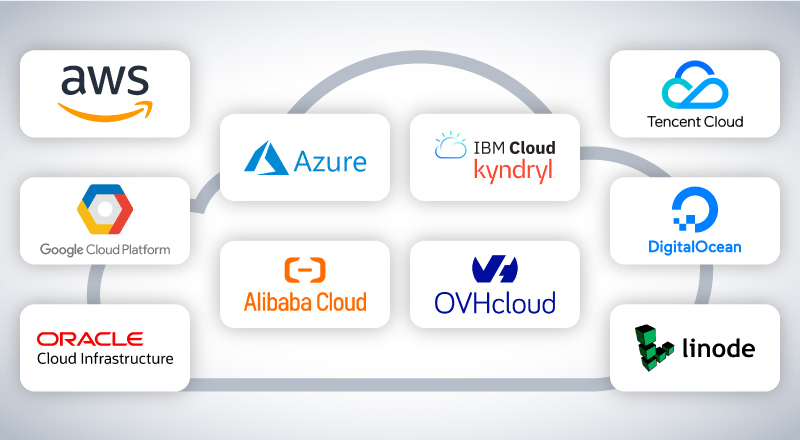

Top Cloud Platforms for Web Development in 2026: Navigating the Modern Ecosystem
Table of Contents
1. Amazon Web Services (AWS): The Mature Industry Standard
2. Microsoft Azure: Seamless Enterprise and Hybrid Integration
3. Google Cloud Platform (GCP): Leadership in Data and AI
4. DigitalOcean: Streamlined Simplicity for Startups
5. Vercel and Netlify: The Evolution of Frontend Cloud
6. The Rise of Serverless and Edge-First Architectures
7. Multi-Cloud and Hybrid Strategies for Resilience
8. Prioritizing Security and Global Compliance
9. Conclusion
Amazon Web Services (AWS): The Mature Industry Standard
In 2026, Amazon Web Services remains the dominant force in the cloud market, offering an unparalleled depth of over 240 specialized services. For web developers, AWS is the go-to for high-scale applications that require extreme customization and global reach. The platform’s latest Graviton4 processors have significantly improved price-performance for web applications, offering up to 30% faster performance than previous generations. With ai agents explained functions types being integrated directly into the AWS management console, developers can now use autonomous agents to monitor resource health and suggest architectural optimizations. While the learning curve for AWS remains steep, its comprehensive documentation and massive ecosystem of third-party tools make it the safest bet for enterprise-grade web platforms that cannot afford downtime or scalability bottlenecks.
Microsoft Azure: Seamless Enterprise and Hybrid Integration
Microsoft Azure has solidified its position in 2026 as the premier choice for businesses heavily invested in the Microsoft software stack. Its deep integration with GitHub and Visual Studio Code provides a frictionless “Commit-to-Cloud” experience that is highly valued by modern DevOps teams. Azure’s leadership in hybrid cloud allows developers to build applications that span seamlessly between on-premises servers and the public cloud, a critical requirement for industries with strict data residency laws. As cybersecurity getting much stronger through Azure’s integrated security lifecycle, developers can deploy applications with built-in protection against the latest AI-powered threats. For mid-to-large organizations, the ability to consolidate identity management through Active Directory while scaling web apps globally makes Azure an exceptionally efficient choice.
Google Cloud Platform (GCP): Leadership in Data and AI
Google Cloud Platform has carved out a distinct niche in 2026 as the “AI and Data Specialist.” For web developers building the next generation of intelligent applications, GCP offers superior tools for machine learning integration and big data analytics via Vertex AI. Google’s infrastructure, built on its private global fiber-optic network, ensures low-latency performance for data-heavy web applications. Using ai tools changing modern workflows, GCP developers can leverage pre-built models for natural language processing and computer vision with minimal configuration. Furthermore, as the creator of Kubernetes, Google continues to offer the most refined managed container experience with GKE (Google Kubernetes Engine), making it the preferred platform for microservices-based web architectures that require complex orchestration.
DigitalOcean: Streamlined Simplicity for Startups
While the hyperscalers focus on the enterprise, DigitalOcean remains the champion of developer experience and transparent pricing in 2026. It is specifically designed for startups and individual developers who need to deploy high-performance “Droplets” or managed databases without navigating thousands of configuration options. DigitalOcean’s App Platform has matured into a powerful PaaS (Platform as a Service) that handles the underlying infrastructure automatically, allowing developers to focus purely on their code. As technology shaping human evolution drives more individuals to launch independent digital ventures, DigitalOcean’s predictable billing and simplified interface lower the barrier to entry for building and scaling sophisticated web products without the “cloud bill shock” often associated with larger providers.
Vercel and Netlify: The Evolution of Frontend Cloud
The specialized “Frontend Cloud” category, led by Vercel and Netlify, has revolutionized web development by 2026. These platforms have moved beyond simple static hosting to provide comprehensive environments for framework-driven development (like Next.js or Nuxt). They prioritize the “Developer Experience” (DX) by offering instant previews, automated CI/CD, and global edge distribution out of the box. By utilizing ai assistants making life easier for frontend deployments, these platforms can automatically optimize image assets and script loading to ensure perfect Lighthouse scores. For teams focused on rapid iteration and high-conversion user interfaces, these platforms provide a specialized workflow that hyperscalers often struggle to match in terms of speed and simplicity.
The Rise of Serverless and Edge-First Architectures
By 2026, the “Serverless First” mindset has become the standard for new web projects. Platforms like AWS Lambda, Azure Functions, and Cloudflare Workers allow developers to run code in response to events without managing any servers. This “Function-as-a-Service” (FaaS) model is now being extended to the “Intelligent Edge,” where code runs at locations physically closest to the user to eliminate latency. Using smart devices learning from you and your location, edge computing ensures that web applications respond instantaneously, regardless of the user’s geographical distance from a central data center. This architecture not only improves the user experience but also offers significant cost savings, as businesses only pay for the exact millisecond their code is executing.
Multi-Cloud and Hybrid Strategies for Resilience
Resilience has become a top priority in 2026, leading to the widespread adoption of multi-cloud and hybrid strategies. Rather than relying on a single provider, developers are architecting web applications to be “Cloud Agnostic,” using tools like Terraform and Pulumi to deploy across multiple environments. This prevents vendor lock-in and protects against provider-specific outages. As ai tools to study faster and analyze cloud performance in real-time become available, automated systems can now shift workloads between AWS and GCP based on current pricing or latency. This strategic flexibility ensures that web platforms remain highly available and cost-effective, leveraging the unique strengths of different cloud providers to create a more robust and optimized digital presence.
Prioritizing Security and Global Compliance
In the complex digital environment of 2026, security is no longer an afterthought but a foundational component of the web development lifecycle. Cloud platforms now offer integrated “Sovereign Clouds” to help businesses comply with increasingly strict local data privacy laws. These environments ensure that sensitive user data never leaves a specific jurisdiction. The ethics of artificial intelligence in security are also being prioritized, with platforms using AI to detect and block malicious traffic while ensuring user privacy is maintained. For web developers, this means that features like automated SSL management, DDoS protection, and encrypted secrets management are now standard, allowing them to build secure-by-default applications that protect both the business and its global user base.
Conclusion
The landscape of cloud platforms for web development in 2026 is defined by a wealth of choices, each catering to specific project needs and organizational goals. Whether you prioritize the sheer power and service depth of AWS, the enterprise synergy of Azure, the AI-driven innovation of Google Cloud, or the developer-centric simplicity of DigitalOcean, the modern cloud provides the tools necessary to build world-class web applications. As we move deeper into an era of edge computing and AI-integrated development, the ability to select and master the right platform has become a critical competitive advantage. By focusing on scalability, security, and developer efficiency, web engineers can leverage these powerful ecosystems to create digital experiences that are not only high-performing but also resilient and future-proof. The evolution of the cloud is far from over, and the platforms that continue to prioritize both advanced intelligence and human-centric design will lead the next wave of web innovation.
References and Further Reading:
Product Hunt: Best Cloud Platforms 2026 |
Elementor: Ultimate Guide to Cloud Hosting |
Simplilearn: Cloud Computing Trends 2026