
Mastering Core Web Vitals in 2026: The Comprehensive Technical Strategy
Table of Contents
1. Largest Contentful Paint (LCP): Cracking the 2.5s Barrier in 2026
2. Interaction to Next Paint (INP): The New Interactivity Standard
3. Cumulative Layout Shift (CLS): Engineering Total Visual Stillness
4. The Role of Edge Computing and Serverless Architecture
5. AI-Driven Performance and Predictive Resource Preloading
6. Infrastructure & TTFB: The Foundation of Modern Speed
7. Managing the “Hidden” Performance Killers: Third-Party Scripts
8. Real-User Monitoring (RUM) and Continuous Auditing
9. Conclusion
Largest Contentful Paint (LCP): Cracking the 2.5s Barrier in 2026
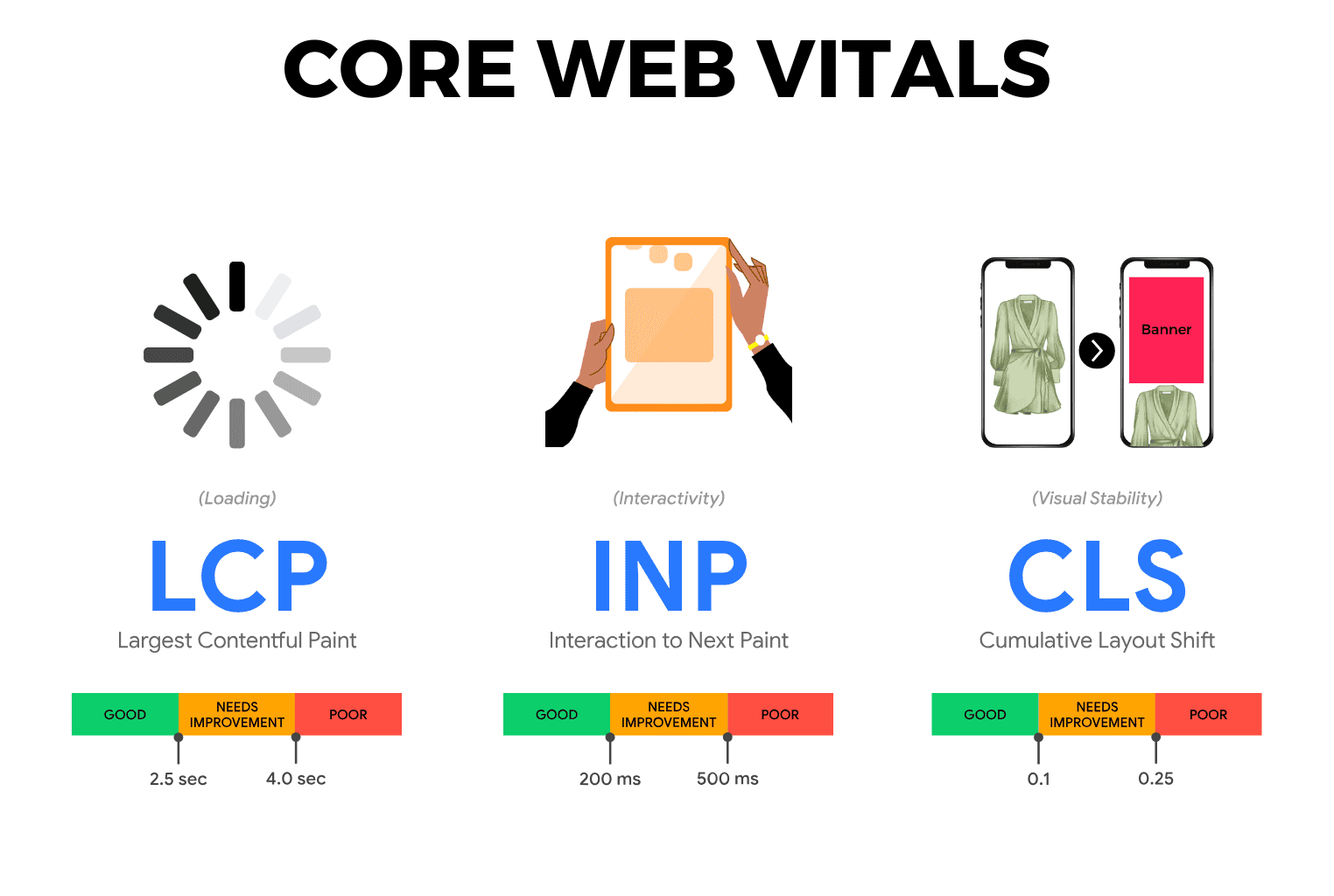
Largest Contentful Paint remains the primary metric for perceived loading speed, measuring the time it takes for the most substantial content element in the viewport to render. In 2026, achieving a “Good” LCP of 2.5 seconds or less is complicated by the rise of high-resolution displays and complex hero media. The most critical mistake modern sites make is hiding the LCP element behind JavaScript or complex CSS selectors. To optimize LCP, you must ensure the primary image or text block is discoverable by the browser’s preload scanner immediately. This is achieved by using the fetchpriority="high" attribute on the LCP element, signaling to the browser that this specific asset must be prioritized over all others. Furthermore, as ai tools changing modern workflows allow for dynamic content generation, you must be careful not to lazy-load content that appears “above-the-fold.”
Another vital component of LCP in 2026 is the adoption of next-generation image formats. While WebP was once the gold standard, AVIF has taken its place by offering up to 50% better compression without visible quality loss. High-performing sites now use responsive image syntax (the picture element with srcset) to serve different file sizes and formats based on the user’s device capabilities. This prevents a mobile user on a 4G connection from downloading a 4K hero image meant for a desktop. By ensuring your LCP element is lean, prioritized, and immediately discoverable, you create a fast-loading experience that satisfies both Google’s crawlers and your human visitors.
Interaction to Next Paint (INP): The New Interactivity Standard
In 2026, Interaction to Next Paint has completely redefined how we measure responsiveness. Unlike the deprecated FID, which only looked at the very first interaction, INP considers every click, tap, and keyboard entry a user makes during their entire visit. A “Good” INP score of under 200ms requires an aggressive strategy against “Main Thread Blocking.” The main thread is like a single-lane highway; if a massive JavaScript task is taking up the lane, the user’s click cannot get through, resulting in perceived lag. To solve this, developers must “Yield to the Main Thread” by breaking long-running scripts into smaller, asynchronous tasks. Using setTimeout(0) or the newer scheduler.yield() API allows the browser to pause heavy processing to handle user input immediately.
As ai agents explained functions types become common in web interfaces, the amount of client-side processing has skyrocketed. The modern solution is to offload non-UI logic to Web Workers. Web Workers run scripts in a background thread, entirely separate from the main thread, ensuring that complex data processing doesn’t freeze the user interface. Additionally, optimizing event handlers is essential. Avoid “heavy” operations inside click listeners; instead, update the UI immediately with a loading state and handle the logic asynchronously. This ensures that the user receives immediate visual feedback, which is the core goal of a high INP score.
Cumulative Layout Shift (CLS): Engineering Total Visual Stillness
Cumulative Layout Shift measures the visual stability of a page. There is nothing more frustrating for a user than a button moving just as they are about to click it. In 2026, achieving a CLS score of 0.1 or lower is about “Space Reservation.” Every piece of media—images, videos, and especially third-party ads—must have explicit dimensions defined in the HTML or CSS. By providing width and height attributes, the browser can calculate the aspect ratio and reserve the exact amount of space before the content actually loads. This prevents “jumps” that occur when a large image suddenly pops into place. As smart devices learning from you and your location to serve personalized ads, these dynamic elements are the most frequent causes of layout shifts.
Another subtle cause of CLS in 2026 is the loading of custom web fonts. “Flash of Unstyled Text” (FOUT) or “Flash of Invisible Text” (FOIT) can cause text to shift as the custom font replaces the system fallback. To combat this, use the font-display: optional property, which tells the browser only to use the custom font if it’s already cached or loads almost instantly. For non-optional fonts, use the Font Loading API to ensure the transition between the fallback and the custom font is seamless. By treating layout stability as a foundational design requirement rather than a final touch-up, you ensure a professional, polished experience that builds user trust and satisfies search engine requirements for visual excellence.
The Role of Edge Computing and Serverless Architecture
In 2026, the physical distance between your server and the user is a major performance bottleneck. Standard centralized hosting is no longer enough for global audiences. Leading websites now utilize “Edge Computing” via platforms like Cloudflare, Vercel, or AWS Edge. By moving both static assets and dynamic logic to the network’s “edge”—locations physically closest to the user—you can reduce latency to a few milliseconds. Edge Functions allow you to perform tasks like A/B testing, authentication, and localization without the need for a round-trip to a main server. As cybersecurity getting much stronger at the edge, these platforms can also block malicious bots and DDoS attacks before they ever reach your infrastructure, further improving response times.
The synergy between Serverless and Edge is particularly beneficial for LCP. By using “Edge-Side Rendering” (ESR), you can generate the HTML for a page at the edge location and stream it to the user. This results in a near-instant Time to First Byte (TTFB), which is the bedrock of a fast LCP. Furthermore, edge platforms can automatically optimize your images and scripts “on-the-fly” based on the user’s specific browser and connection speed. This eliminates the need for complex build-step optimizations and ensures that every visitor, whether they are on a high-speed fiber connection in New York or a limited mobile network in a rural area, receives an experience tailored specifically for their conditions.
AI-Driven Performance and Predictive Resource Preloading
The most innovative development in 2026 web performance is the use of AI for predictive preloading. Rather than preloading every asset and wasting bandwidth, modern performance engines use machine learning to predict which page a user is likely to visit next. By analyzing cursor movement, scroll depth, and historical navigation patterns, the system can begin fetching the necessary resources for the next page in the background. Using ai assistants making life easier for developers, these AI tools can be integrated with just a few lines of code. This “Speculative Loading” turns a standard website into a proactive interface that anticipates user needs, often resulting in “Instant” page transitions that register as zero seconds in performance logs.
Beyond navigation, AI is also used for real-time “Adaptive Performance.” If the system detects that a user’s device is struggling with CPU usage (potentially impacting INP), it can automatically disable non-essential animations or lower the resolution of background videos. Similarly, AI models can analyze your site’s JavaScript bundles to identify unused code and suggest “Code Splitting” strategies that were previously overlooked. This level of granular, automated optimization allows small teams to achieve the same performance levels as giant tech corporations. By letting AI handle the complex calculations of resource prioritization, developers are free to focus on building features and improving user engagement.
Infrastructure & TTFB: The Foundation of Modern Speed
While frontend metrics like LCP and INP get the most attention, they are entirely dependent on your backend infrastructure. Time to First Byte (TTFB) is the measurement of how long it takes for a user’s browser to receive the first byte of data from your server. In 2026, a “Good” TTFB is under 200ms. If your server is slow to respond, every other metric will suffer as a result. High-performance sites prioritize “Zero-Latency Infrastructure,” which involves optimized database queries, SSD-based storage, and the latest network protocols like HTTP/3 (QUIC). HTTP/3 is particularly important as it significantly reduces connection setup times, especially on unreliable mobile networks, by allowing data to start flowing before a full “handshake” is completed.
Efficient caching strategies are the second pillar of a strong TTFB. This involves not just browser caching, but also “Object Caching” for your database and “Full-Page Caching” on the server. For businesses using platforms like WordPress, this means moving away from bulky plugins and toward server-level caching solutions like Nginx FastCGI or Redis. As wearables tracking smart activities and other IoT devices become more common as web clients, your infrastructure must be able to handle a high volume of small, frequent requests without crashing. A robust, scalable infrastructure ensures that your Core Web Vitals remain stable even during sudden traffic spikes, protecting both your SEO rankings and your brand’s reputation for reliability.
One of the biggest obstacles to a perfect Core Web Vitals score in 2026 is the accumulation of third-party scripts. From analytics and heatmaps to chatbots and social media embeds, these scripts are often unoptimized and can completely derail your INP and LCP scores. Every third-party script you add is a new “Point of Failure” and a new task for the main thread. To manage this, leading developers use the “Façade Pattern.” For example, instead of loading a heavy YouTube embed immediately, you show a static image of the video with a play button. The actual YouTube player only loads when the user clicks the play button. This keeps your initial page load lean while still providing full functionality when requested.
For essential scripts like analytics, the 2026 standard is to use “Partytown” or similar libraries to run them inside a Web Worker. This prevents the scripts from competing with your site’s primary logic for time on the main thread. Additionally, you should conduct a “Quarterly Script Audit” to identify and remove any trackers or features that are no longer being used. As ai tools to study faster and analyze site behavior become more advanced, you can often consolidate multiple third-party tools into a single, more efficient solution. Treating your “JavaScript Budget” as a finite resource that must be spent wisely is the only way to maintain a high-performance site in an increasingly complex web ecosystem.
Real-User Monitoring (RUM) and Continuous Auditing
The final stage of mastering Core Web Vitals is the move from “Lab Data” to “Field Data.” While tools like Lighthouse provide a great starting point, they only simulate a single user in a perfect environment. Google ranks your site based on the Chrome User Experience Report (CrUX), which collects data from actual visitors over a 28-day period. To succeed in 2026, you must implement Real-User Monitoring (RUM) to see how your vitals perform across different devices, browsers, and geographic regions in real-time. RUM tools like Vercel Analytics or DebugBear allow you to see exactly where your “Poor” and “Needs Improvement” scores are coming from, enabling you to fix issues before they impact your overall ranking.
Performance optimization is not a one-time event; it is a continuous cycle of auditing and refinement. As you add new features or content, your vitals will naturally fluctuate. Establishing a “Performance Budget” for your development team—for example, ensuring that no pull request increases total JavaScript by more than 10KB—is essential for long-term stability. As ethics of artificial intelligence become a larger part of the tech conversation, providing a fast, accessible, and energy-efficient website is also seen as a part of a company’s social responsibility. By committing to continuous performance monitoring, you ensure that your website remains an elite digital asset that provides value to your users and maintains its dominance in the search engine landscape of 2026.
Conclusion
Optimizing for Core Web Vitals in 2026 is a complex but rewarding endeavor that sits at the intersection of technical excellence and user empathy. By focusing on the “Three Pillars”—Loading (LCP), Interactivity (INP), and Visual Stability (CLS)—you build a digital experience that is not only favored by Google’s algorithms but is also deeply satisfying for your visitors. The move toward edge-native architectures, AI-driven predictive preloading, and a leaner approach to JavaScript represents the future of the high-performance web. As the internet continues to evolve into a faster and more intelligent space, those who prioritize these performance metrics will be the ones who lead the market. Remember, every millisecond saved is a potential customer retained and a step closer to the top of the search results. Stay proactive, stay technical, and always put the user’s experience first in every development decision you make.
References and Further Reading:
Google Search Central: Core Web Vitals Documentation |
Web.dev: Learn Web Vitals for Developers |
SearchX: Core Web Vitals Explained for 2026