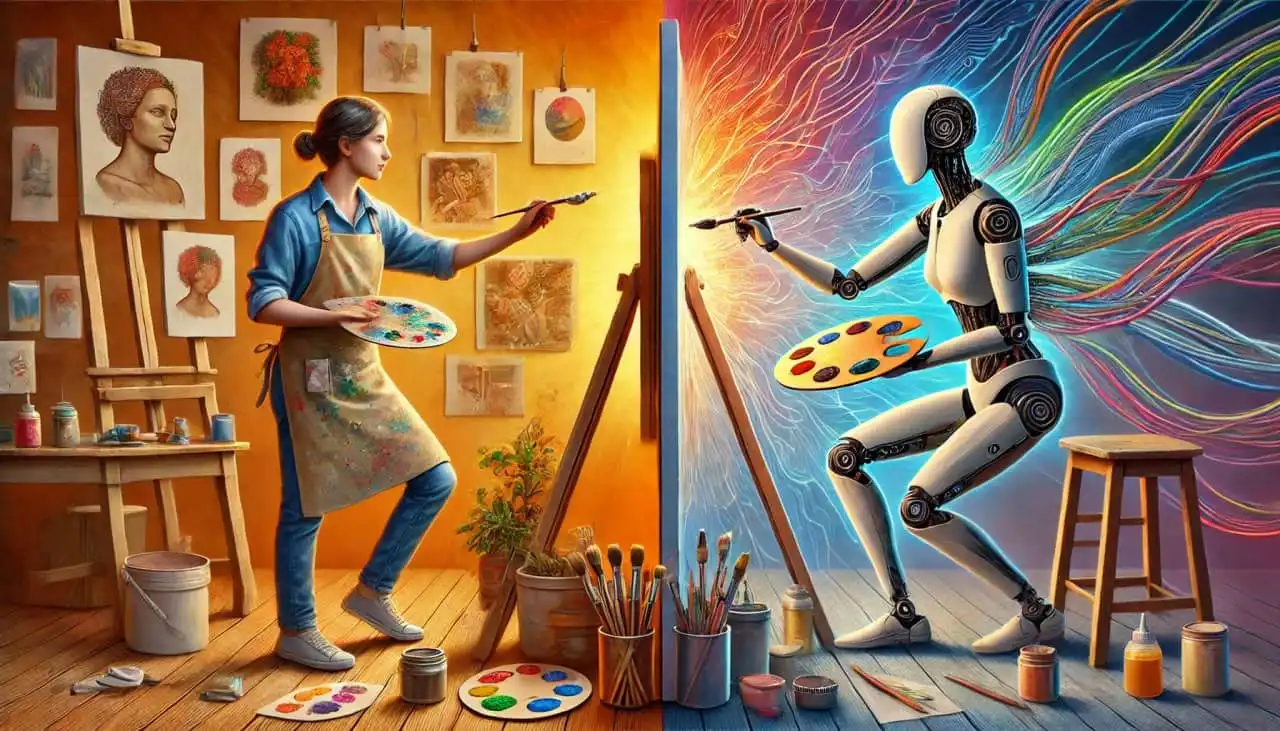
The “Doom Scenarios” of 2024 predicted that by January 2026, human creativity would be obsolete. They were wrong. Walk into any top-tier design studio in New York, London, or Tokyo today, and you won’t see empty desks. You will see something far more interesting: Humans working faster, smarter, and more strategically than ever before, flanked by digital colleagues.
We have entered the era of “The Augmented Auteur.” The question is no longer “Will AI replace me?” but rather “Can I orchestrate a team of AI agents to execute my vision?”
I am Mr. Phone Khant, and I have spent the last few years analyzing the collision between Generative Models and the Global Creative Economy. What I see today is a “Great Reset”—a fundamental change in how value is assigned to creative work. The premium has shifted from execution (how well you draw) to curation (how good your taste is). Here is your roadmap to navigating this brave new world.
Table of Contents: The Global Blueprint
- 1. The Structural Shift: From Production to Orchestration
- 2. The Economic Reality: The “Junior Gap” Crisis
- 3. New Job Titles of 2026: World Builders & Synth-Archivists
- 4. Visual Design: Spatial Computing & The XREAL Factor
- 5. The “Slop” Fatigue: Why Human Writing is Premium
- 6. Global Case Study: The 48-Hour Super Bowl Ad
- 7. The Legal Landscape: Licensing Your “Style”
- 8. Future-Proofing Strategy: The “Soul” Metric
- 9. Mr. Phone Khant’s Verdict
- 10. Frequently Asked Questions (FAQ)
1. The Structural Shift: From Production to Orchestration
In the traditional agency model of the early 2020s, the structure was a pyramid: a few Creative Directors at the top, supported by a massive base of Junior Designers and Copywriters doing the grunt work. In 2026, that pyramid has inverted into a diamond.
The Rise of Agentic Workflows
We are no longer just “prompting” chatbots. We are assigning tasks to Autonomous Agents. In a modern London branding firm, a Senior Designer doesn’t manually resize a logo for 50 different social media formats. They simply tell their layout agent: “Adapt this campaign for Instagram, TikTok, and digital billboards, ensuring the primary color hex code remains consistent.”
The agent executes this in minutes. This shift means the creative professional is now an Orchestrator. The value lies in defining the parameters of the work, not in doing the work itself. The “Middleman” of production—the person whose job was just to move files around or make minor edits—has effectively been automated out of existence.
2. The Economic Reality: The “Junior Gap” Crisis
This efficiency comes with a dark side, which economists are calling the “Junior Gap.” Since AI can now handle the entry-level tasks (research, basic drafting, storyboarding) that used to be the training ground for young creatives, the ladder has broken.
Global hiring data from January 2026 shows a 40% drop in “Junior Creative” job postings compared to 2023. However, salaries for “Senior AI Creative Technologists” have risen by nearly 60%.
“The market is paying a premium for ‘Hybrid Minds’—people who understand color theory and composition, but also understand Python scripts and LoRA model training.”
For new entrants to the global market, the advice is clear: You cannot just be a ‘learner’ anymore. You must come to the table as a ‘specialist’ in how to leverage tools to bypass the junior phase entirely.
3. New Job Titles of 2026: World Builders & Synth-Archivists
As old roles fade, entirely new archetypes are appearing on job boards in Silicon Valley and Berlin. These aren’t just buzzwords; they are high-paying career paths.
A. The World Builder
With the convergence of gaming engines (Unreal Engine 6) and Generative AI, brands aren’t just making ads; they are making interactive worlds. A “World Builder” uses AI to generate infinite assets—textures, NPCs, dialogue trees—to populate immersive brand experiences. They are half-architect, half-programmer.
B. The Synthetic Data Archivist
Models need to be trained. High-end fashion houses are hiring archivists to curate their historical designs, scan them, and train private, proprietary AI models. This ensures that when the AI generates a new dress design, it carries the specific “DNA” of the brand, not a generic internet aesthetic.
4. Visual Design: Spatial Computing & The XREAL Factor
The hardware we use to create has changed. The days of being hunched over a 2D monitor are ending. With the release of devices like the XREAL 1S and the maturation of the Apple Vision ecosystem, design is becoming Spatial.
Designers in 2026 are manipulating 3D AI-generated objects in mid-air. [attachment_0](attachment) This allows for “Rapid Prototyping” at a speed previously impossible. A car designer can generate a 3D concept of a vehicle, walk around it in their living room, adjust the curves with hand gestures, and then ask the AI to “render this in a desert environment at sunset.”
This integration of Spatial Computing and Generative AI means that the barrier between “imagining” an object and “seeing” it has effectively dissolved.
By 2025, the internet was flooded with what cultural critics called “AI Slop”—endless, mediocre, SEO-generated articles that all sounded the same. In 2026, we are seeing the backlash.
The Authenticity Premium
Global media outlets and brands are now paying top dollar for what AI cannot do: First-Person Perspective. An AI can summarize a report about a coffee shop, but it cannot tell you how the espresso smelled or the specific hum of conversation in the room.
Writers who lean into their humanity—their flaws, their unique voice, their specific lived experiences—are finding that their work is more valuable than ever. We are seeing a rise in “Human-Verified” badges on content platforms, signalling to readers that a human nervous system was involved in the creation of the text.
6. Global Case Study: The 48-Hour Super Bowl Ad
To illustrate the speed of the 2026 creative economy, let’s look at a recent case from a boutique agency in Los Angeles. They were tasked with creating a 30-second spot for a major beverage brand. In 2023, this would have taken 3 months and a $2 million budget.
The 2026 Workflow:
- Hour 1-4: The Creative Director brainstormed concepts with an LLM trained on 50 years of award-winning ads.
- Hour 5-12: Instead of hiring a storyboard artist, they used a real-time video generation model (Sora v3) to create a high-fidelity “Videomatic” (a moving storyboard).
- Hour 13-36: They filmed the human actors on a green screen.
- Hour 37-48: The background, lighting, and visual effects were generated and composited by AI agents in real-time.
The result? A broadcast-quality commercial produced in two days. The team consisted of just five people.
7. The Legal Landscape: Licensing Your “Style”
The legal battles of the mid-2020s have settled into a new business model: The Licensing of LoRAs (Low-Rank Adaptation models).
Famous illustrators and photographers are no longer just selling prints; they are selling access to their AI clones. An art director can legally “rent” the style of a famous photographer for a specific campaign. The artist gets paid a royalty for every image generated using their model. This has turned “Style” into a tangible, tradable asset class, much like a music copyright.
8. Future-Proofing Strategy: The “Soul” Metric
In a world where execution is instant and cheap, what becomes expensive? Taste, Empathy, and Curation.
I advise all creative professionals to focus on the “Soul Metric.” Ask yourself: “Does this work make the viewer feel understood?” AI operates on probability; it predicts the next likely pixel or word. Great art often operates on *improbability*—the surprising choice that breaks the pattern. That capability remains uniquely human.
As I touched upon in my analysis of Global Financial Trends, the future belongs to those who use technology to amplify their humanity, not replace it.
9. Mr. Phone Khant’s Verdict
The “Great Creative Reset” of 2026 is not an extinction event; it is an evolution event. The creatives who are suffering today are those who insisted on being “hands.” The creatives who are thriving are those who have become “minds.”
The tools available to us today—from XREAL glasses to Agentic Swarms—are the most powerful creative instruments in human history. They have lowered the floor for entry but infinitely raised the ceiling for quality. The canvas has changed, but the need for a visionary artist remains exactly the same.
10. Frequently Asked Questions (FAQ)
Q: Is it too late to get into graphic design in 2026?
A: No, but the job description has changed. Don’t learn just tools; learn Design Thinking and AI Workflow Management.
Q: Will AI video replace Hollywood?
A: It hasn’t replaced it, but it has democratized it. We are seeing blockbuster-quality films coming from small indie teams, forcing major studios to innovate on storytelling rather than just spectacle.