
AR Shopping Becoming More Immersive
Table of Contents
- The Leap from Novelty to Necessity: Defining Immersive AR Shopping
- Spatial Computing: The Technical Core of True Realism and Anchoring
- Hyper-Realism in Fit and Texture: The Evolution of Virtual Try-On
- AI and Generative Models: Automating Personalization and Catalog Creation
- Sensory Fusion: Beyond Visuals with Haptics and Spatial Audio
- The Hardware Shift: Moving from Smartphones to AR Glasses
- The Phygital Store: Blending In-Store and Virtual Experiences
- Impact on E-commerce Metrics: Conversion, Confidence, and Returns
- Ethical Data Usage and the Privacy Challenge of Contextual AR
- Conclusion: The Future of Commerce is Seamlessly Augmented
The Leap from Novelty to Necessity: Defining Immersive AR Shopping
Augmented Reality (AR) shopping has transcended its initial phase as a technological novelty and established itself as an indispensable tool that bridges the confidence gap inherent in e-commerce. The initial attempts at AR visualization were often crude, involving static, poorly scaled 3D models floating unconvincingly within a user’s environment. Today, the field is defined by a pursuit of **hyper-realism** and deep **contextual awareness**, making virtual products virtually indistinguishable from their physical counterparts when viewed through a device. This exponential increase in immersivity is directly addressing the shopper’s most significant hurdle: the uncertainty of purchase—specifically, “Will this fit me?” and “Will this look right in my space?”
The success of the new generation of AR experiences—from virtually placing a sofa in a living room to trying on makeup shades on a smartphone—is measurable in tangible business outcomes like higher conversion rates and drastically reduced product returns. This shift is powered by a convergence of advanced technologies, including sophisticated spatial mapping, generative AI, and high-fidelity rendering engines that work in real time. For retailers, immersive AR is no longer a futuristic experiment; it is a strategic requirement for maintaining competitiveness, offering a rich, personalized, and risk-mitigated shopping journey that actively increases customer engagement and brand loyalty. The goal has evolved from simply showing a product to enabling the customer to truly **experience** the product in their own environment before the transaction is finalized.
Spatial Computing: The Technical Core of True Realism and Anchoring
The foundation of highly immersive AR shopping is the maturation of **Spatial Computing**. This discipline allows digital content to not only appear in the real world but to seamlessly understand, interact with, and adapt to the physical environment. Older AR technologies relied on simple plane detection, often resulting in virtual objects that jittered or floated unconvincingly. Modern spatial computing employs advanced sensors—including Lidar scanners and depth cameras, particularly common in newer smartphones and dedicated AR headsets—to create a persistent, highly accurate **digital twin** of the user’s space.
This technical leap enables several key features that enhance immersion. The most critical is **object occlusion**, which allows virtual items to be partially or fully hidden by real-world furniture or walls, making the virtual object feel genuinely anchored within the scene. Furthermore, spatial computing ensures objects are displayed at **true scale and perspective**, eliminating the guesswork about size and proportion, which is crucial for products like furniture or appliances. Beyond static placement, the system now computes real-time environmental data, such as ambient lighting and surface textures, enabling products to cast realistic shadows, reflect light accurately, and blend seamlessly with the scene. This complex, high-fidelity spatial anchoring is what transforms an AR projection from a digital sticker into a convincingly tangible, interactive object within the shopping experience.
Hyper-Realism in Fit and Texture: The Evolution of Virtual Try-On
The most demanding and rapidly evolving area of AR shopping immersion is the **Virtual Try-On (VTO)** experience, especially for fashion, beauty, and accessories. The goal of VTO has moved far beyond simply superimposing a static image onto a user’s face or body. Contemporary VTO utilizes advanced body scanning and photorealistic rendering techniques to simulate how fabrics, materials, and cosmetics interact with the human body in real time.
For apparel, this involves complex **cloth simulation algorithms** that digitally replicate the drape, stretch, and movement of different fabrics. When a user moves their body, the virtual garment reacts convincingly, showing wrinkles, shadows, and how the material adheres to the user’s unique body shape. This level of realism helps consumers accurately gauge fit and look, significantly reducing the primary cause of returns in online fashion retail. In the beauty sector, AR now accurately simulates how light interacts with different makeup formulas—from matte to glossy finishes—on a user’s unique skin tone and under their specific lighting conditions. Furthermore, accessories like eyewear and jewelry are rendered with high-fidelity metallic and reflective properties. These hyper-realistic interactions instill a level of purchasing confidence that directly mimics the in-store experience, thereby completing the essential loop of product visualization and consumer trust.
AI and Generative Models: Automating Personalization and Catalog Creation
Artificial Intelligence (AI), particularly generative models, is the invisible engine that scales immersive AR shopping and drives personalization. Historically, creating the high-fidelity 3D models necessary for AR was a time-consuming and expensive manual process, limiting the size of a retailer’s AR-enabled catalog. **Generative AI** is fundamentally changing this by automating the creation of vast numbers of photorealistic 3D assets from standard 2D product images, dramatically reducing the time and cost required to bring an entire product line into the immersive realm.
Beyond asset creation, AI is central to delivering **hyper-personalized AR experiences**. AI agents analyze a user’s historical shopping behavior, contextual AR data (like the colors or styles of furniture already present in their scanned room), and even their social media engagement to provide intelligent, proactive product recommendations that are immediately placed into their environment. For instance, if an AI detects that a user is scanning a rustic living room with exposed wood, it will instantly overlay product recommendations that align with that specific aesthetic. Furthermore, AI enables **virtual styling assistance**, offering mix-and-match clothing suggestions or coordinating decor pieces, transforming the passive try-on into an active, guided styling session. This intelligent, real-time personalization elevates the user experience from merely viewing a product to receiving tailored, contextual shopping advice.
Sensory Fusion: Beyond Visuals with Haptics and Spatial Audio
While the visual fidelity of AR is approaching photorealism, the next frontier in immersion involves integrating other senses, most notably touch and sound. The integration of advanced **haptic feedback** in accompanying wearable devices, controllers, or even future smart apparel is designed to replicate the sensation of interacting with a virtual product. Although rudimentary on mobile devices, future AR glasses and specialized gloves could allow a user to virtually “touch” a piece of furniture and receive tactile feedback simulating the smoothness of polished wood or the roughness of a natural fiber rug.
Equally important is **Spatial Audio**, which ensures that the immersive experience is aurally convincing. When a virtual object is placed in a room, spatial audio can make sounds—such as the whir of a virtual vacuum cleaner, the chime of a digital doorbell, or the running water from a virtual faucet—appear to originate from the object’s specific, accurate location in the room. This sound anchoring significantly enhances the user’s perception of presence and realism, especially for appliances or electronic devices where sound is a crucial product feature. The fusion of high-fidelity visuals with believable tactile and auditory feedback systems is what truly closes the gap between the digital object and the perception of a real-world object, creating a fully rounded and convincing simulated presence.
The Hardware Shift: Moving from Smartphones to AR Glasses
For years, the smartphone has served as the necessary but constrained window into the augmented world. However, the next major leap in AR shopping immersion is dependent upon the widespread adoption of dedicated **AR Smart Glasses and Headsets**. Devices designed for spatial computing, such as those released by major tech companies, offer several advantages over the mobile phone that dramatically enhance the immersive experience.
Crucially, these dedicated wearables offer a much wider **Field of View (FoV)** and superior resolution, allowing the user to see virtual products across their entire visual spectrum without being confined to a small screen. Secondly, they enable **hands-free interaction**, allowing users to manipulate virtual objects with natural gestures and movements rather than tapping a screen, making the shopping experience more intuitive and physically engaging. Thirdly, the advanced sensor arrays built into AR glasses provide far more accurate and persistent **world-tracking**, ensuring that virtual objects remain perfectly anchored and stable, even as the user moves freely around their home. This transition from viewing a product through a handheld window to having products seamlessly overlaid directly onto the user’s world will make the AR shopping experience passive, always-on, and fundamentally more immersive and integrated into daily life.
The Phygital Store: Blending In-Store and Virtual Experiences
Immersive AR is not only transforming online shopping; it is also revolutionizing the traditional brick-and-mortar retail experience through the creation of **”Phygital”** (Physical-Digital) stores. In this blended environment, AR acts as a layer that enhances the physical store, providing personalized information and utility that was previously only available online. Examples include AR-enabled in-store navigation, where a user’s phone or smart glasses can display a virtual path directly to a specific product within a large, confusing supermarket or mall.
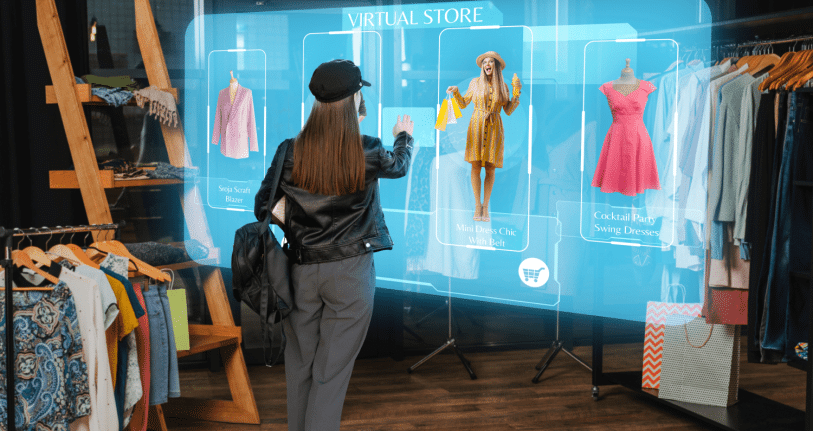
More sophisticated applications involve **smart mirrors** and interactive displays. These AR mirrors allow shoppers to instantly try on dozens of clothing or makeup combinations without ever having to step into a physical fitting room, providing the immediacy of the digital world within the comfort of the physical store. Furthermore, when a shopper examines a physical product, AR can instantly overlay rich, contextual information—such as customer reviews, pricing comparisons, or instructional videos—providing a deep level of detail without requiring a store associate. This blending of the online convenience with the physical presence creates a superior, seamless customer journey that maximizes both efficiency and experiential engagement.
Impact on E-commerce Metrics: Conversion, Confidence, and Returns
The transition to more immersive AR shopping is producing measurable, highly positive impacts on critical e-commerce performance indicators. The primary benefit is a significant **increase in conversion rates**. When a customer can accurately visualize a product in their own space, their purchasing confidence soars. Studies consistently show that products featuring an AR experience achieve conversion rates up to three times higher than those relying solely on static 2D imagery. This correlation between immersion and confidence is a direct driver of sales growth.
Furthermore, immersive AR significantly addresses the costly problem of **product returns**. For items like furniture, apparel, and footwear, a large percentage of returns are due to size, fit, or aesthetic mismatch. By allowing the customer to check the scale, see the color in their lighting, and visually confirm the fit, AR effectively pre-qualifies the purchase, drastically reducing the rate of returns. This not only saves retailers significant operational costs but also improves customer satisfaction and reduces the overall environmental footprint of e-commerce logistics. The enhanced immersion translates directly into better business outcomes, proving the financial justification for investment in sophisticated AR technology.
Ethical Data Usage and the Privacy Challenge of Contextual AR
As AR shopping becomes more immersive and contextually aware, new and complex challenges arise regarding **data privacy and ethical usage**. Modern immersive AR requires constant access to highly sensitive, real-time spatial data, including detailed 3D maps of a user’s home, the presence of specific furniture or decor, and potentially even behavioral biometrics captured by AR glasses. This wealth of personal, contextual data, while enabling hyper-personalization, creates unprecedented privacy risks.
The industry is being forced to prioritize a transparent, **Privacy by Design** approach. This involves clear communication to users about what spatial data is collected and how it is stored, as well as the immediate adoption of techniques like **local processing** (Edge Computing) to ensure that sensitive 3D map data of a user’s home never leaves their device. Ethical considerations also extend to targeted advertising and behavioral profiling based on the contents of a user’s home. The continued growth of immersive AR shopping requires a careful balance where the benefits of rich, personalized experiences are strictly governed by transparent data practices, ensuring that enhanced utility does not come at the expense of user trust and autonomy.
Conclusion: The Future of Commerce is Seamlessly Augmented
The transformation of AR shopping into a profoundly immersive experience is redefining the future of retail. This shift is not merely cosmetic; it is built on the rigorous technical foundation of spatial computing, generative AI, and advanced photorealistic rendering. By solving the fundamental problem of purchasing uncertainty, AR boosts confidence, drastically lowers returns, and drives conversion rates to new heights. As dedicated smart glasses replace the smartphone as the primary AR window, and as haptics and spatial audio integrate with visuals, the distinction between browsing a virtual product and physically encountering it will continue to fade. The future of commerce is a unified, seamless **Augmented Reality layer** that provides a personalized, context-aware, and highly trusted shopping journey, making the act of buying less of a transaction and more of an effortless, integrated life experience.
References
AR Shopping Trends & Realism (Techgenyz) |
Redefining Retail with Immersive Spaces (Forbes) |
Spatial Computing in Retail (ByondXR)